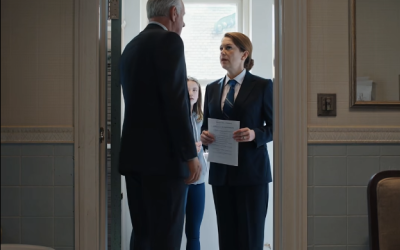
He reached inside his coat. He did not produce a business card. He produced a heavy, cream-colored envelope.
“I believe this provides the necessary context,” he said.
I took it. Inside was a photograph—not a printout, but a real silver halide photograph, thick and glossy. It was thirty years old. A young woman, beautiful and defiant, stood on the deck of a sailboat. She looked exactly like me. She was laughing. Standing next to her, his hand possessively on her shoulder, was a much younger Elias Rothwell. It was my mother. My mother who had died when I was 20. My mother who had always told me her parents were not in the picture, that they had disowned her for marrying my father. She had raised me alone on a teacher salary, telling me we had no one else.
“You knew my mother,” I whispered, the photo shaking in my hand.
“She was my daughter,” Elias said, his face softening—just for a fraction of a second, a flicker of an ancient pain. “I am your grandfather. We have been estranged by circumstance, by choices made long ago, not by my desire.”
He looked past me at the motel room, then back at my face.
“And I find you here—31 years old, a brilliant résumé in your hand, and locked out of your own life by petty thieves.”
He knew. I didn’t know how he knew, but the certainty in his voice was absolute.
“I don’t understand,” I said. It was the only thing I could say.
He nodded toward the waiting helicopter, the open door.
“I did not fly through a blizzard to reminisce, Zoey. I came to correct an error.”
He stepped back, holding the motel door open for me.
“Get your coat,” he said, his voice flat, resolute. “We are going to Boston. It is time to see the things that actually belong to you.”
The flight was a rupture in time. The helicopter cabin was pressurized and quiet, the rotor blades a dull thrum far above us. We flew over the storm, not through it. Elias Rothwell did not speak. He sat opposite me, belted into a cream-colored leather seat, reading a dense financial report as if we were on a commuter train. He hadn’t asked about my mother, my life, or the 31 years he had missed. He had confirmed his identity, assessed my résumé, and taken possession of my circumstances. I watched the ice crystals form on the reinforced glass, my mind struggling to stitch the two realities together. The grandfather I never knew was a billionaire, and my boyfriend and cousin were apparently thieves. The betrayal from Mason and Kira was a sharp, mundane pain. The appearance of Elias was something else entirely—vast, cold, and incomprehensible, like the atmosphere at 30,000 feet. We landed at a private airfield north of Boston when the sky was a deep, bruised purple—not yet dawn, maybe 4:00 a.m. A black sedan, identical to the ones that wait for CEOs, was idling on the tarmac. The driver took my single overnight bag. We drove into the city. The streets were empty, slick with sleet. The silence in the car was heavy, expectant.
“They believe you are weak,” Elias said, looking straight ahead as the car turned onto my street. “They believe you are isolated. They are counting on a hysterical reaction followed by a quiet retreat. It is what my daughter—your mother—would have done. She always chose retreat.”
The words stung, a calculated prick of my pride.
“I am not my mother,” I said.
“That is what the résumé suggests,” he replied. “Now we will see.”
The lobby of my building was warm. The overnight security guard asleep at his desk. We took the elevator to the 12th floor. Elias remained two steps behind me, an observer. I walked down the familiar carpeted hallway to my apartment. 12:14. The smart lock on my door looked different. The faceplate was new, a more expensive model than the one the building provided. My key fob, when I held it up, resulted in a sharp negative beep-beep-beep and a red light. My access code—my mother’s birthday—I typed it in. Access denied. Rage, cold and pure, washed over the shock. I balled my fist and struck the door. Not a panicked pounding, but three heavy, measured blows. I heard movement inside, muffled voices, a chain being drawn. The deadbolt turned. The door opened four inches. My cousin Kira Hail peered out. Her blonde hair was a mess from sleep. She was wearing my gray silk robe—the one Mason had given me for Christmas. Her eyes widened, first in surprise, then in a slow, dawning satisfaction.
“Zoe. My God. What are you doing here? It’s the middle of the night.”
“Why is the lock changed? Kira, where is Mason?”
“He’s asleep,” she lied, pulling the robe tighter.
I pushed the door. She stumbled back, and I stepped into the entryway of my own apartment, and my world tilted. It was my apartment, but it was wrong. The smell was wrong. It smelled like Mason’s mother—Cynthia—a heavy gardenia perfume. My large abstract painting from the entryway was gone, replaced by a cheap, guilt-framed mirror. My coat rack was overflowing with coats I didn’t recognize. In the living room, my modular sofa had been rearranged. My books. My possessions. My entire life had been packed into a dozen cardboard banker’s boxes stacked against the far wall, labeled in Kira’s sloppy handwriting: ZOE STORAGE. Mason was in the kitchen, illuminated by the light over the stove. He was wearing boxers and a T-shirt, stirring something in a saucepan. He froze when he saw me, the spoon halfway to his mouth.
“Zoe,” he breathed.
He looked pale, guilty, terrified.
“What is this?” I demanded. My voice was steady, lower than I expected. “What did you do?”
“Honey, who is it?” a voice called from my bedroom.
Mason’s mother, Cynthia Dallow, emerged, tying the belt on her own bathrobe. She stopped dead. Behind her, Mason’s father in pajamas squinted at me. They were living here. All of them. Cynthia was the first to recover. She put on a look of strained pity.
“Zoe, we—we didn’t expect you back. We thought you’d be in River Forge for the week.”
“You changed my locks,” I said.
Kira stepped up beside me, her arms crossed. The fear was gone, replaced by a brazen smirk.
“We had to, Zoe. You just left. You abandoned the lease.”
“I went upstate for two days,” I said, my voice vibrating.
“You took your résumé,” Kira countered, gesturing to the empty spot on the hall table where I usually dropped my work bag. “You were clearly planning on leaving. You’ve been complaining about Helio Quarry Brands for months. When we saw you’d packed—”
“You packed my things,” I stated.
For Complete Cooking STEPS Please Head On Over To Next Page Or Open button (>) and don’t forget to SHARE with your Facebook friends.